
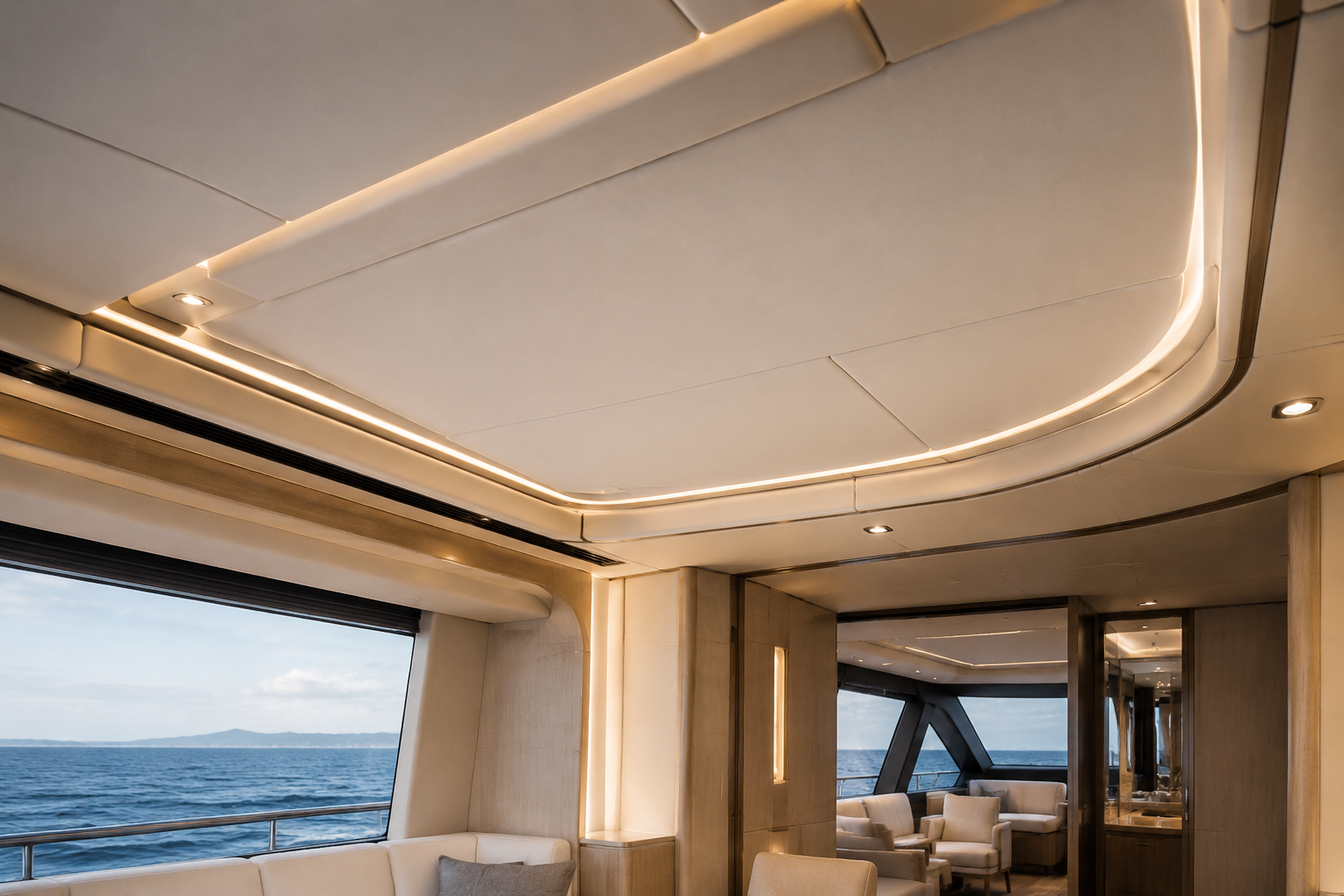
The finish is only part of the system
A yacht headliner must create a refined visual plane while accommodating compound curves, vibration, lighting, speakers, air-conditioning outlets, hatches and access to equipment. The best system is selected around both the desired appearance and the way the vessel must be serviced.
Stretched fabric or removable panels
Stretched-fabric systems can produce clean, continuous surfaces and resolve complex geometry. Panelized systems divide the finish into removable sections that can simplify service access. Many interiors benefit from a carefully planned combination of both approaches.
- Consider how frequently systems behind the finish require access
- Map every light, grille, speaker and hatch
- Plan seam and panel lines as part of the design
- Confirm how curves and transitions will terminate
Material selection matters
Headliner textiles and backing materials should be evaluated for appearance, cleanability, stability and suitability for the marine environment. Acoustic cores may help manage reflected sound, but their thickness and placement must work with available space and adjacent details.
Measure after surrounding work is stable
Accurate templates depend on stable cabinetry, trim and equipment locations. On a new build, the headliner team should coordinate early but verify final geometry at the correct construction stage. On a refit, hidden conditions should be documented before the replacement system is finalized.